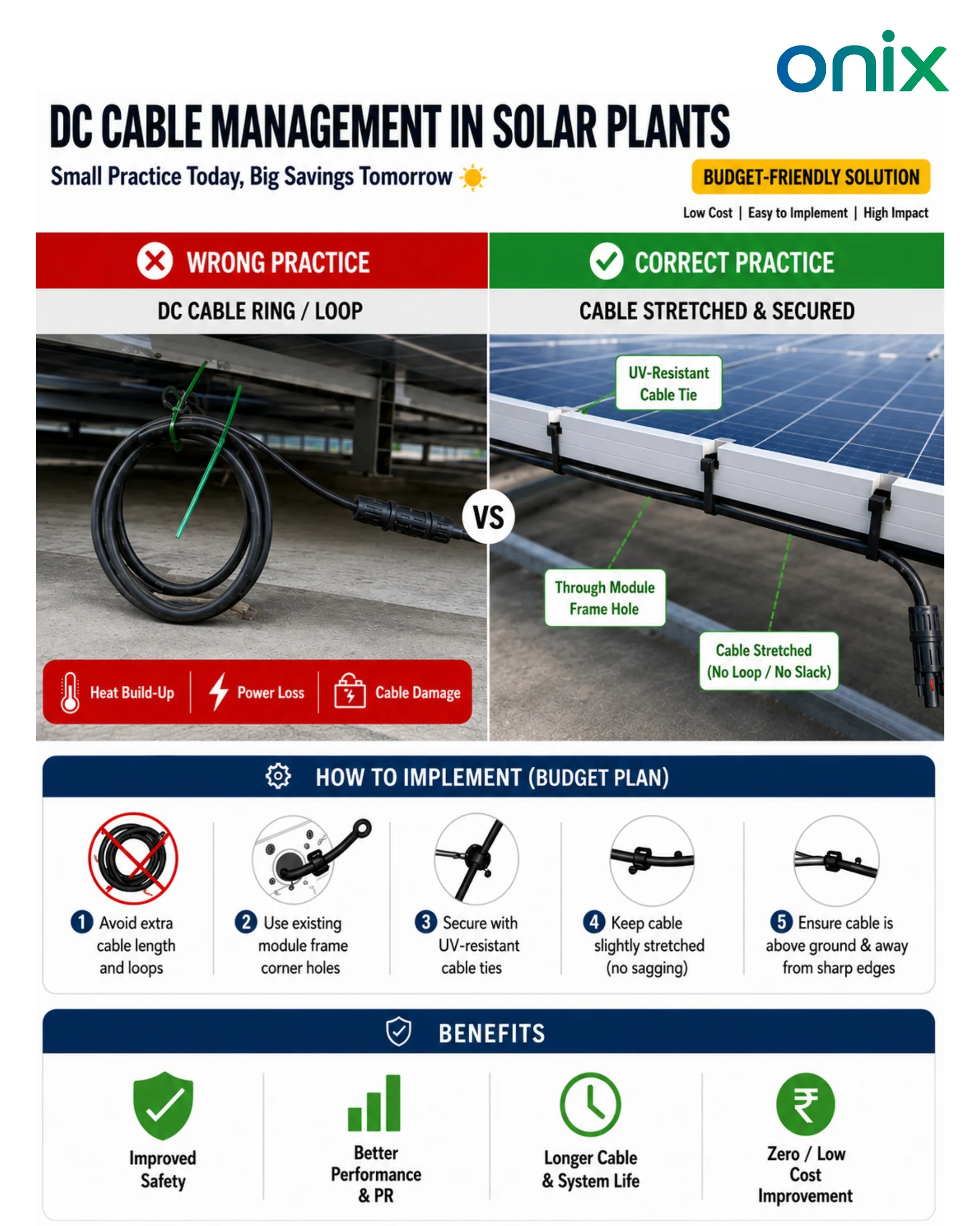
In utility-scale and commercial solar PV plants, attention is usually focused on high-efficiency solar modules, premium inverters, and advanced monitoring systems. However, one of the most cost-effective ways to improve plant performance lies in an often-overlooked area—DC cable management.
Although DC cables represent a relatively small portion of the overall project cost, improper routing, support, and protection can lead to energy losses, equipment failures, increased maintenance costs, and even fire hazards. Investing in proper DC cable management is a small practice that delivers substantial long-term savings.
This article explores why DC cable management matters, common installation mistakes, industry best practices, and how these seemingly minor improvements contribute to safer, more reliable, and more profitable solar PV plants.
DC cables serve as the backbone of every solar photovoltaic system, carrying electricity generated by solar modules to combiner boxes and inverters. Since these cables remain energized whenever sunlight is available, they require careful handling throughout the plant's operational life.
Proper cable management offers several advantages:
Ignoring cable management can significantly increase operational risks and maintenance expenses over the life of a solar installation.
Many solar projects experience cable-related issues due to rushed installations or poor-quality accessories.
Loose cables hanging beneath module structures experience continuous movement caused by wind. Over time, this movement causes abrasion and insulation wear.
Using non-UV-resistant cable ties or accessories leads to cracking and cable sagging after prolonged sun exposure.
Cables rubbing against galvanized steel structures eventually lose insulation, increasing the risk of short circuits and ground faults.
Improper cable routing creates low points where rainwater collects, accelerating cable degradation.
Poorly protected cable routes become vulnerable to rodents, resulting in costly repairs and unexpected downtime.
Leaving unnecessary cable lengths creates clutter, increases wear, and complicates maintenance activities.
Many plant owners underestimate how cable issues affect profitability.
Improper cable management can lead to:
Even a single ground fault caused by damaged DC cables can reduce plant output until repairs are completed. Across large solar farms, repeated failures can translate into substantial annual revenue losses.
Always select high-quality UV-stabilized cable ties or stainless-steel fastening systems designed for outdoor environments.
Support cables at regular intervals to prevent movement caused by wind and vibration.
Maintain recommended bending radii to reduce mechanical stress on conductors.
Proper cable organization simplifies maintenance and minimizes the risk of accidental damage.
Install edge protection or cable clips wherever cables pass near metal components.
Design cable routes carefully to reduce unnecessary voltage drop and material costs.
Clear identification improves maintenance efficiency and reduces troubleshooting time.
Ensure installation complies with applicable electrical standards and manufacturer recommendations.
Good DC cable management directly contributes to safer solar installations.
Benefits include:
Safety improvements not only protect equipment but also safeguard maintenance personnel working within the plant.
The cumulative savings from proper cable management can be significant over a plant's 25-year lifespan.
Potential benefits include:
Compared to the total project investment, the cost of proper cable supports, clips, and routing practices is minimal, making cable management one of the highest-return preventive measures available.
Successful solar PV projects rely on attention to detail. While solar modules and inverters receive most of the attention, the supporting infrastructure—including DC cable management—plays an equally important role in ensuring dependable performance.
A well-managed cable system improves plant aesthetics, simplifies maintenance, minimizes failures, and supports consistent energy generation throughout the asset's operational life.
As solar installations continue to grow in size and complexity, asset owners are placing greater emphasis on reliability and lifecycle optimization. Modern cable management systems, improved materials, and stricter installation standards are helping developers reduce operational risks while maximizing energy production.
Future solar projects are expected to incorporate smarter cable routing designs, enhanced inspection technologies, and more durable fastening systems that further improve plant performance.
DC cable management may appear to be a minor installation detail, but its impact on the long-term success of a solar PV plant is substantial. Proper routing, securing, labeling, and protection of DC cables reduce maintenance costs, improve safety, enhance reliability, and maximize energy generation.
For developers, EPC contractors, and plant owners, adopting best practices in DC cable management represents a small investment that delivers significant savings over the life of the project. In solar power, success often depends on getting the small details right—and DC cable management is one of the most important among them.