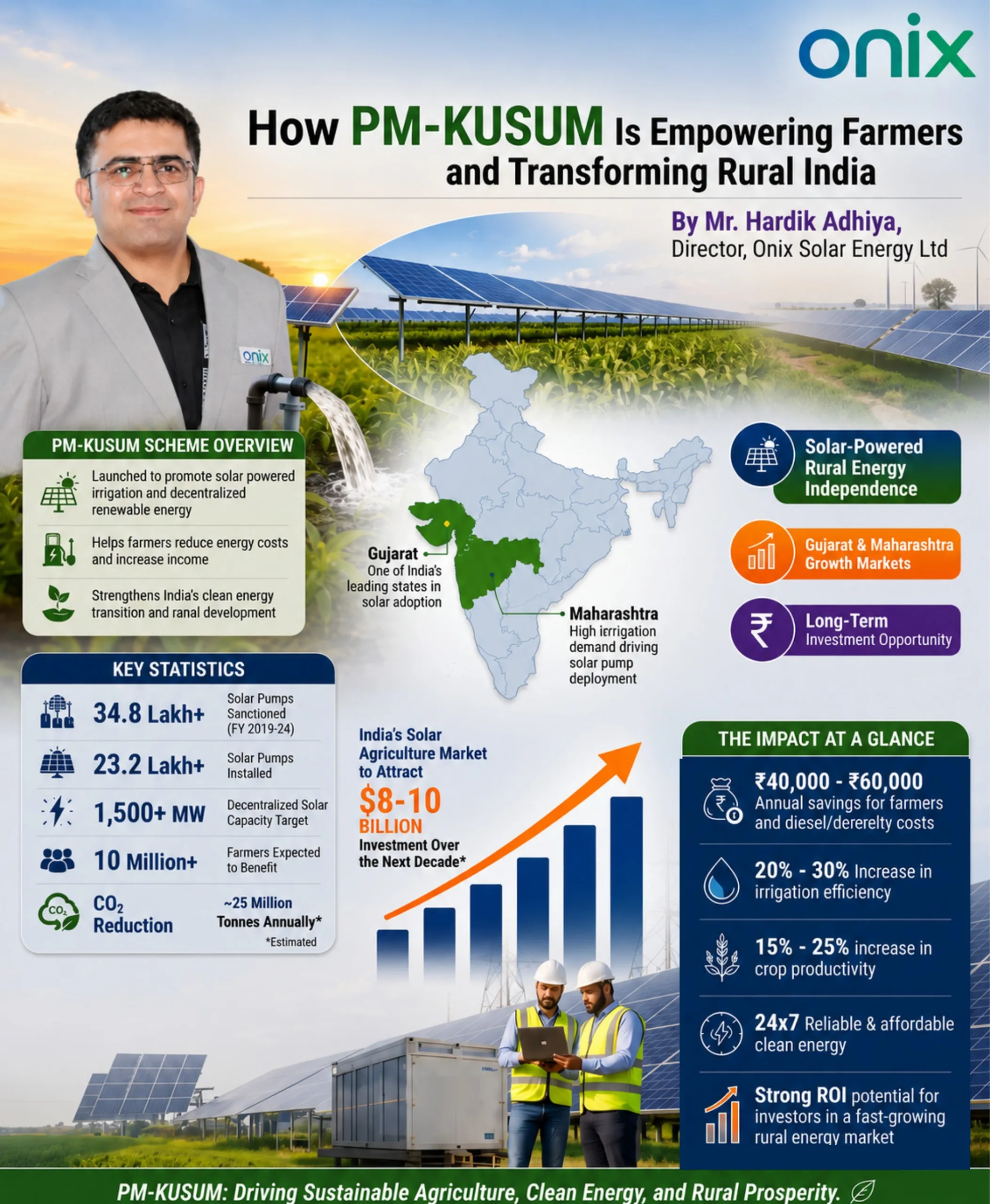
India's rural economy is undergoing a significant transformation. Traditionally dependent on agriculture and monsoon cycles, rural communities are now becoming active participants in the country's renewable energy revolution. At the center of this shift is the Pradhan Mantri Kisan Urja Suraksha evam Utthaan Mahabhiyan (PM-KUSUM), a flagship government initiative designed to promote solar energy adoption among farmers.
More than just a renewable energy program, PM-KUSUM is emerging as one of India's most promising rural investment opportunities. By enabling farmers to generate electricity, reduce irrigation costs, and earn additional income through power sales, the scheme is creating a sustainable economic model that benefits both individuals and the nation.
Launched by the Government of India, PM-KUSUM aims to increase farmers' income while reducing dependence on conventional energy sources. The scheme supports the installation of solar-powered irrigation pumps, grid-connected solar power plants, and the solarization of existing agricultural infrastructure.
The program is divided into three major components:
Farmers, cooperatives, and rural entrepreneurs can install small solar power plants on barren or unused land and sell electricity to local distribution companies.
Farmers receive financial assistance to replace diesel-powered irrigation systems with solar-powered pumps, reducing fuel expenses and environmental impact.
Existing grid-connected agricultural pumps can be solarized, allowing farmers to use solar energy for irrigation and export surplus electricity to the grid.
The growing interest in PM-KUSUM extends beyond farmers. Investors, renewable energy developers, and infrastructure companies are increasingly recognizing its long-term value.
Solar power plants developed under PM-KUSUM often operate under long-term power purchase agreements (PPAs), creating stable and predictable revenue generation.
Unlike many traditional rural investments, solar assets offer recurring cash flows with relatively low operational costs after installation.
One of the strongest attractions of PM-KUSUM is the substantial financial support provided by the government. Capital subsidies significantly reduce project costs, improving returns for participants.
Government backing also lowers policy risks, making renewable energy investments more attractive for institutional and private investors.
India's electricity demand continues to rise, particularly in rural and semi-urban regions. Distributed solar generation helps meet this demand while strengthening local energy infrastructure.
As rural electrification and agricultural modernization accelerate, demand for reliable energy solutions is expected to grow further.
PM-KUSUM is reshaping rural economics in multiple ways.
Traditionally, farmers relied heavily on crop yields for income. Solar power generation introduces a second income source that is less vulnerable to weather conditions or commodity price fluctuations.
Farmers can monetize unused land by leasing it for solar projects or directly participating in power generation initiatives.
Diesel fuel costs have historically placed significant financial pressure on agricultural operations. Solar pumps eliminate recurring fuel expenses and reduce dependence on grid electricity.
The result is improved profitability and greater financial stability for farming households.
The installation, operation, and maintenance of solar infrastructure generate employment opportunities in rural areas. Local technicians, electricians, contractors, and service providers benefit from increased demand.
This contributes to broader rural economic development and skill enhancement.
Renewable energy developers are playing a crucial role in accelerating PM-KUSUM adoption.
Companies specializing in solar project development, engineering, procurement, and construction (EPC) services are helping bridge the gap between government policy and ground-level implementation.
Organizations such as Onix Renewable are actively supporting the transition by providing technical expertise, project execution capabilities, and sustainable energy solutions tailored to rural requirements.
As awareness increases, collaborations between farmers, developers, financial institutions, and government agencies are expected to strengthen the ecosystem further.
Investors can participate directly in solar power projects established under PM-KUSUM, benefiting from long-term energy sales and attractive returns.
Owners of non-agricultural or underutilized land can generate passive income by leasing land for solar development.
The expansion of distributed solar generation creates opportunities in transmission systems, energy storage, monitoring technologies, and maintenance services.
Banks, NBFCs, and impact investors are increasingly supporting renewable energy projects through innovative financing structures designed specifically for rural solar investments.
India has set ambitious renewable energy targets, and decentralized solar generation will play a critical role in achieving them. PM-KUSUM aligns perfectly with national objectives related to energy security, climate sustainability, and farmer welfare.
As technology costs continue to decline and policy support remains strong, the scheme is expected to attract greater private participation in the coming years.
The convergence of agriculture, renewable energy, and rural development creates a unique investment landscape rarely seen in emerging markets.
For investors seeking stable, sustainable, and socially impactful opportunities, PM-KUSUM represents a compelling long-term proposition.
PM-KUSUM is much more than a government solar initiative—it is a catalyst for rural economic transformation. By empowering farmers, attracting private investment, and accelerating renewable energy adoption, the scheme is creating a new model of inclusive and sustainable growth.
As India's clean energy ecosystem continues to evolve, PM-KUSUM stands out as one of the most promising rural investment opportunities of the decade. Stakeholders who recognize this shift early may benefit not only from attractive financial returns but also from contributing to a greener and more prosperous future for rural India.
Author: Mr. Hardik Adhiya, Director, Onix Solar Energy Ltd