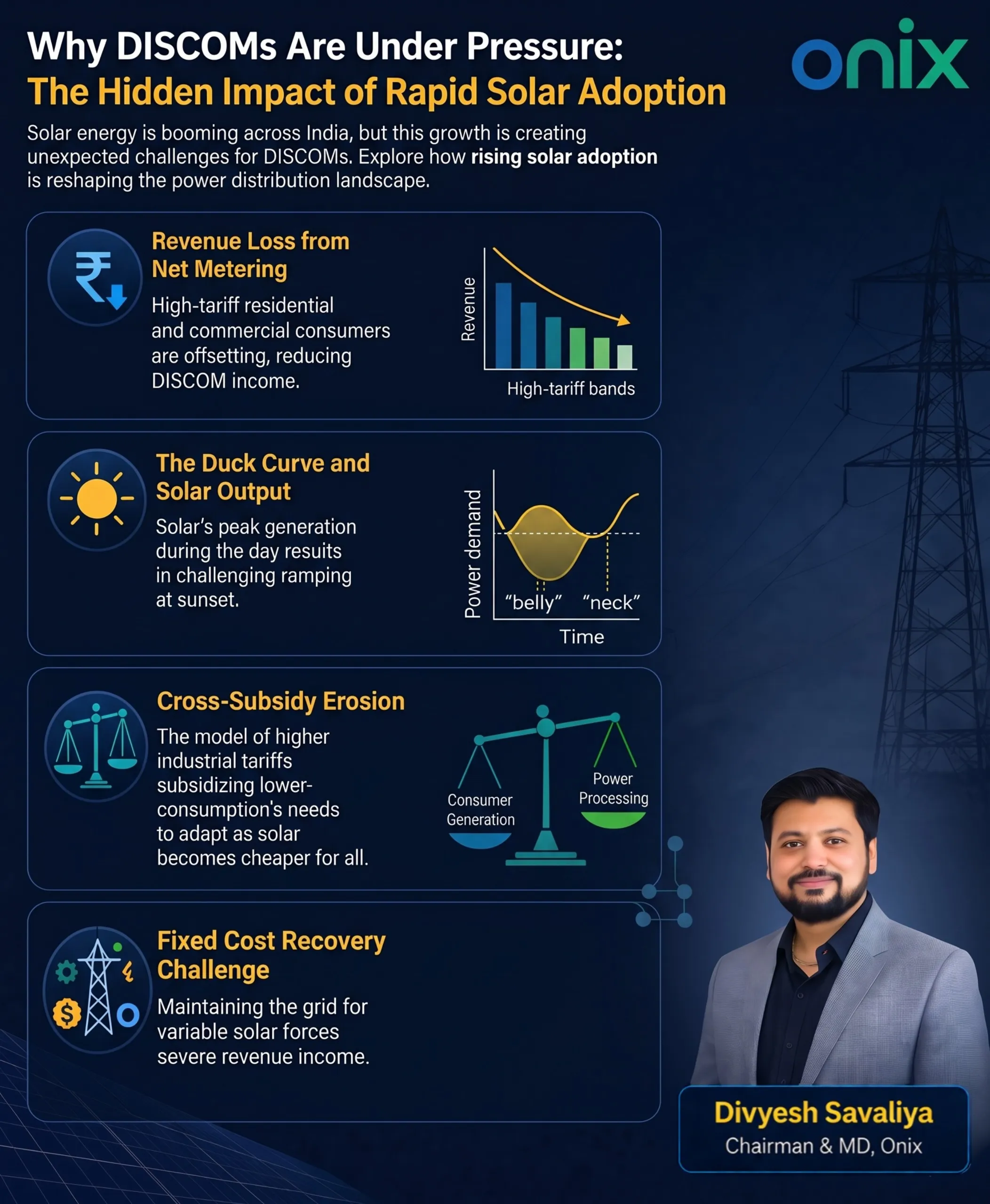
India’s renewable energy transition is accelerating at an extraordinary pace, with solar energy leading the charge. While this shift is a positive step toward sustainability and energy independence, it has introduced complex challenges for power distribution companies (DISCOMs). From declining revenues to grid management issues, the rapid rise in solar adoption is reshaping the traditional electricity distribution model.
In this article, we explore why DISCOMs are facing pressure due to increasing solar adoption, through the lens of industry leadership and real-world operational insights.
Solar energy has emerged as a dominant force in India’s power sector. Government initiatives such as rooftop solar subsidies, net metering policies, and ambitious renewable energy targets have encouraged widespread adoption among residential, commercial, and industrial consumers.
The decreasing cost of solar panels and advancements in technology have further accelerated installations. Businesses and households are now generating their own electricity, reducing dependence on traditional grid power.
DISCOMs have historically relied on a cross-subsidy model, where industrial and commercial consumers pay higher tariffs to subsidize residential and agricultural users. However, these high-paying consumers are now the fastest adopters of rooftop solar systems.
As a result, DISCOMs are losing their most profitable customer segments. This leads to:
The financial stress is further amplified as fixed infrastructure costs remain unchanged despite declining electricity sales.
Net metering policies allow solar consumers to export excess electricity back to the grid, effectively reducing their electricity bills. While beneficial for consumers, this creates a financial imbalance for DISCOMs.
DISCOMs are obligated to purchase surplus power at regulated rates, often higher than their average procurement cost. This results in:
Over time, this model becomes unsustainable without policy adjustments.
The intermittent nature of solar power introduces significant challenges in grid management. Unlike conventional power sources, solar generation fluctuates based on sunlight availability.
This unpredictability leads to:
DISCOMs must invest in advanced grid infrastructure, energy storage systems, and smart technologies to maintain stability—further increasing operational costs.
Even as electricity consumption from the grid declines, DISCOMs must maintain transmission and distribution infrastructure. These fixed costs include:
With reduced revenue and constant expenses, the financial viability of DISCOMs is under serious threat.
Regulatory frameworks have not fully evolved to keep pace with rapid solar adoption. Inconsistent policies across states, delayed tariff revisions, and lack of clarity on net metering limits create uncertainty.
DISCOMs are often caught between promoting renewable energy and maintaining financial sustainability. This balancing act requires:
From a leadership standpoint, the current situation presents both challenges and opportunities. While solar adoption is essential for a sustainable future, it must be integrated in a way that ensures the financial health of DISCOMs.
Key observations include:
A balanced approach can transform disruption into long-term resilience.
The future of India’s energy ecosystem depends on how effectively DISCOMs adapt to this transformation. Strategic reforms and technological innovation will play a critical role.
Possible solutions include:
By aligning renewable growth with financial sustainability, India can build a resilient and future-ready power sector.
The increasing adoption of solar energy marks a pivotal moment in India’s energy journey. However, it also brings significant pressure on DISCOMs, challenging traditional business models and operational frameworks.
To ensure long-term success, it is essential to create a balanced ecosystem where renewable energy growth and DISCOM sustainability coexist. With the right policies, technology, and leadership, this transition can become an opportunity rather than a crisis.